
Casu Marzu
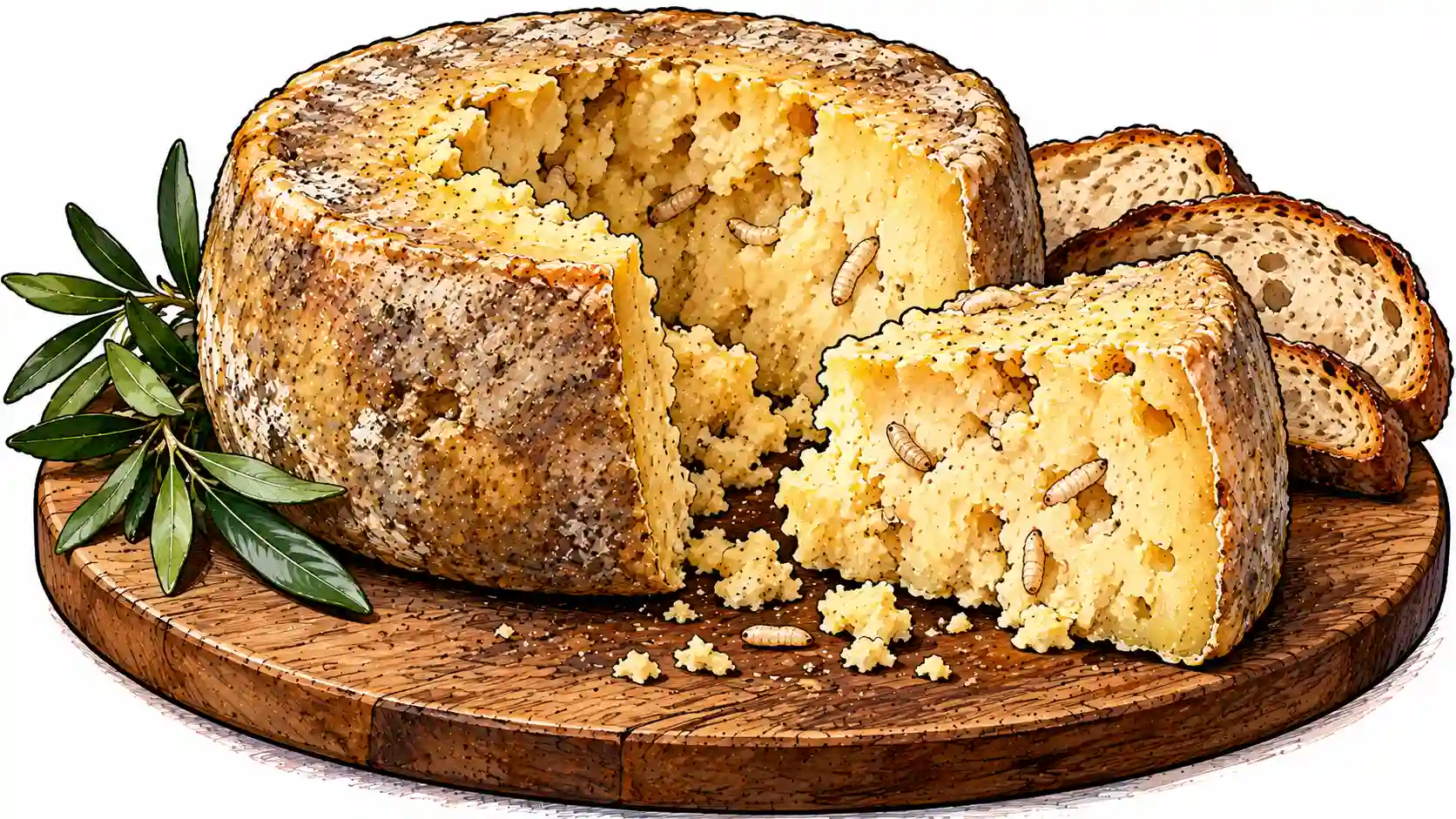
Casu marzu is one of Italy's most controversial traditional foods. Originating in Sardinia, this unusual cheese is known for containing live insect larvae that help break down its interior, creating an exceptionally soft texture and a powerful flavor. Its name is commonly translated as "rotten cheese," and its distinctive production method has attracted international attention. For many Sardinians, however, casu marzu is connected to a long tradition of sheep farming, cheesemaking, and rural food culture. Its reputation also comes with an important caveat: the cheese raises food safety concerns and faces significant legal restrictions on production and sale.
What Is Casu Marzu?
Casu marzu is a traditional Sardinian cheese usually made from sheep's milk cheese related to pecorino. Its defining feature is the presence of live fly larvae, commonly associated with the cheese fly Piophila casei. The flies lay eggs in the cheese, and the larvae hatch and feed on it, helping break down fats and proteins and changing its texture.
As the cheese develops, its interior becomes exceptionally soft, moist, and creamy. The flavor is often described as intense, pungent, and sharply savory, although its exact characteristics vary with the underlying cheese and the ripening process. Traditional casu marzu is distinguished from ordinary aged sheep's milk cheese by the deliberate involvement of live larvae.
Although casu marzu is sometimes described as a fermented cheese, that label does not fully explain its unusual production. The larvae's digestive activity contributes to the breakdown of the cheese's components, producing a form of insect-assisted decomposition beyond conventional cheese ripening.
Casu marzu has cultural significance in Sardinia, where sheep farming and pecorino cheesemaking have deep roots. However, its traditional status does not establish that it is safe to eat. The presence of live larvae, variable production conditions, and concerns about biological hazards make food safety a central issue.
Quick Facts
- Origin: Sardinia, Italy
- Main Ingredient: Sheep's milk cheese, usually associated with pecorino
- Traditional Defining Feature: Live cheese-fly larvae
- Commonly Associated Insect: Piophila casei
- Texture: Extremely soft, moist, and creamy
- Flavor: Intense, pungent, and savory
- Cultural Connection: Sardinian pastoral and cheesemaking traditions
- Food Safety: Raises biological safety concerns
- Legal Status: Production and sale face significant restrictions under applicable food-safety rules
Common Ingredients
Casu marzu begins with a traditional sheep's milk cheese. Its distinctive character develops through a ripening process involving cheese-fly larvae rather than through added herbs, spices, or other flavorings. Specific methods and the underlying cheese can vary among traditional producers.
- Sheep's Milk: The primary milk used in the traditional cheese, reflecting Sardinia's longstanding sheep-farming culture. Some descriptions of related local preparations mention other milk sources, so methods should not be assumed to be identical everywhere.
- Rennet: Traditionally used to coagulate the milk and form curds during cheesemaking.
- Salt: Used to season and help preserve the underlying cheese as part of its preparation.
- Cheese-Fly Larvae: The defining feature of traditional casu marzu. Their feeding and digestive activity contribute to the breakdown of the cheese's interior.
- Underlying Sheep's Milk Cheese: Often associated with pecorino-style cheesemaking, although the precise starting cheese and local practices can differ.
Unlike cheeses flavored with herbs or spices, casu marzu develops its unusual texture and pungent character primarily through the biological activity involved in its ripening. The process also makes its microbiological characteristics less predictable than those of a cheese produced under tightly controlled conditions.
How Casu Marzu Is Made
Traditional production begins with sheep's milk cheese, often a pecorino-style cheese that has already undergone some aging. The rind is opened or otherwise prepared to allow cheese flies to reach the interior and lay their eggs. The details of this process vary among producers and local traditions.
After the eggs hatch, the larvae feed on the cheese. Their digestive activity contributes to the breakdown of fats and proteins, gradually changing the cheese from a relatively firm mass into a much softer, more spreadable substance. This transformation is central to the texture associated with casu marzu.
Unlike conventional cheese ripening, which typically relies on selected microorganisms and controlled production conditions, traditional casu marzu deliberately involves insect larvae. The timing, degree of ripening, and resulting characteristics can vary, and the process is not standardized in the same way as many commercial cheese-production methods.
Scientific research into casu marzu has found that larval colonization can affect the cheese's chemical composition and microbiological characteristics, with results varying according to the cheese and production conditions. This variability is important because a creamy texture, strong aroma, or apparently normal appearance cannot establish that a food is safe.
Food safety concerns include possible microbial contamination and the potential hazards associated with ingesting live larvae. Traditional preparation does not guarantee safety, and casu marzu should not be recommended for consumption simply because it is part of a longstanding food tradition.
History & Origins
Casu marzu is rooted in Sardinia's pastoral culture, where sheep farming has shaped the island's economy, landscapes, and cuisine for centuries. Sheep's milk cheeses, including pecorino varieties, have long been important foods, and cheesemaking traditions developed through generations of rural practice.
Within this setting, casu marzu emerged as a distinctive local preparation that uses insect activity to transform cheese. Its precise origins and earliest history are difficult to establish because traditional food practices were often passed down through households and communities rather than recorded in dated recipes or formal historical accounts.
The cheese became known beyond Sardinia because of its unusual production method and the controversy surrounding its consumption. Travel writing and international media have drawn attention to its live larvae, pungent aroma, and creamy texture, sometimes emphasizing its shock value at the expense of its cultural context.
Despite its international notoriety, casu marzu should not be treated as representative of all Italian cheese or even all Sardinian cheese. Sardinia produces many other sheep's milk cheeses, including numerous pecorino varieties, that do not involve live larvae.
Varieties & Differences
Casu marzu is best understood as a traditional category of larvae-ripened cheese rather than a single standardized commercial product. Local names, underlying cheeses, and preparation methods can differ, so descriptions of its appearance, flavor, and production are not always identical.
- Traditional Casu Marzu: The best-known form, associated with Sardinian sheep's milk cheese containing live cheese-fly larvae.
- Local Preparations: Producers and communities may use different starting cheeses and ripening practices, affecting the final texture and intensity.
- Pecorino: A broad family of Italian sheep's milk cheeses, including Sardinian varieties, that are generally made without deliberately introduced live larvae.
- Other Insect-Associated Cheeses: Some European food traditions include cheeses transformed by mites or insect larvae. These products have their own methods and cultural histories and should not automatically be treated as equivalent to casu marzu.
Casu marzu should also not be confused with ordinary blue cheese or other mold-ripened cheeses. Those cheeses rely on selected molds and controlled ripening processes, whereas casu marzu is distinguished by its association with live insect larvae and the resulting breakdown of the cheese's interior.
How Casu Marzu Is Enjoyed
Traditional accounts associate casu marzu with Sardinian food culture and describe it being served in small portions as part of a rustic meal. Sheep's milk cheese is an important part of the island's culinary heritage, and casu marzu represents one of its most unusual expressions.
Descriptions of traditional serving practices often mention spreading the soft cheese onto local bread, including pane carasau, a thin, crisp Sardinian flatbread. Its strong aroma and intense flavor have made it memorable to people familiar with the tradition, while its live larvae have contributed to its reputation beyond the island.
However, casu marzu presents serious food safety concerns. Potential hazards include contamination and risks associated with ingesting live larvae. Its production and sale also face significant restrictions under applicable food-safety rules in Italy and the European Union. The precise legal implications depend on the relevant rules and circumstances, but traditional status alone does not make the product legally marketable or establish that it is safe.
For those interested in Sardinian cheese culture, there are many alternatives that offer a more practical way to explore the island's cheesemaking heritage. Properly produced pecorino and other Sardinian sheep's milk cheeses provide distinctive local flavors without the unusual biological hazards associated with casu marzu.
Did You Know?
Casu marzu's name is commonly translated as "rotten cheese." In Sardinian, the name refers to its unusual state of ripening. Cheese-fly larvae feed inside the cheese and help break down its fats and proteins, creating its characteristic creamy texture. This insect-assisted transformation has made the cheese internationally famous, but it also raises food safety concerns and contributes to restrictions on its production and sale.