
Spaghettieis
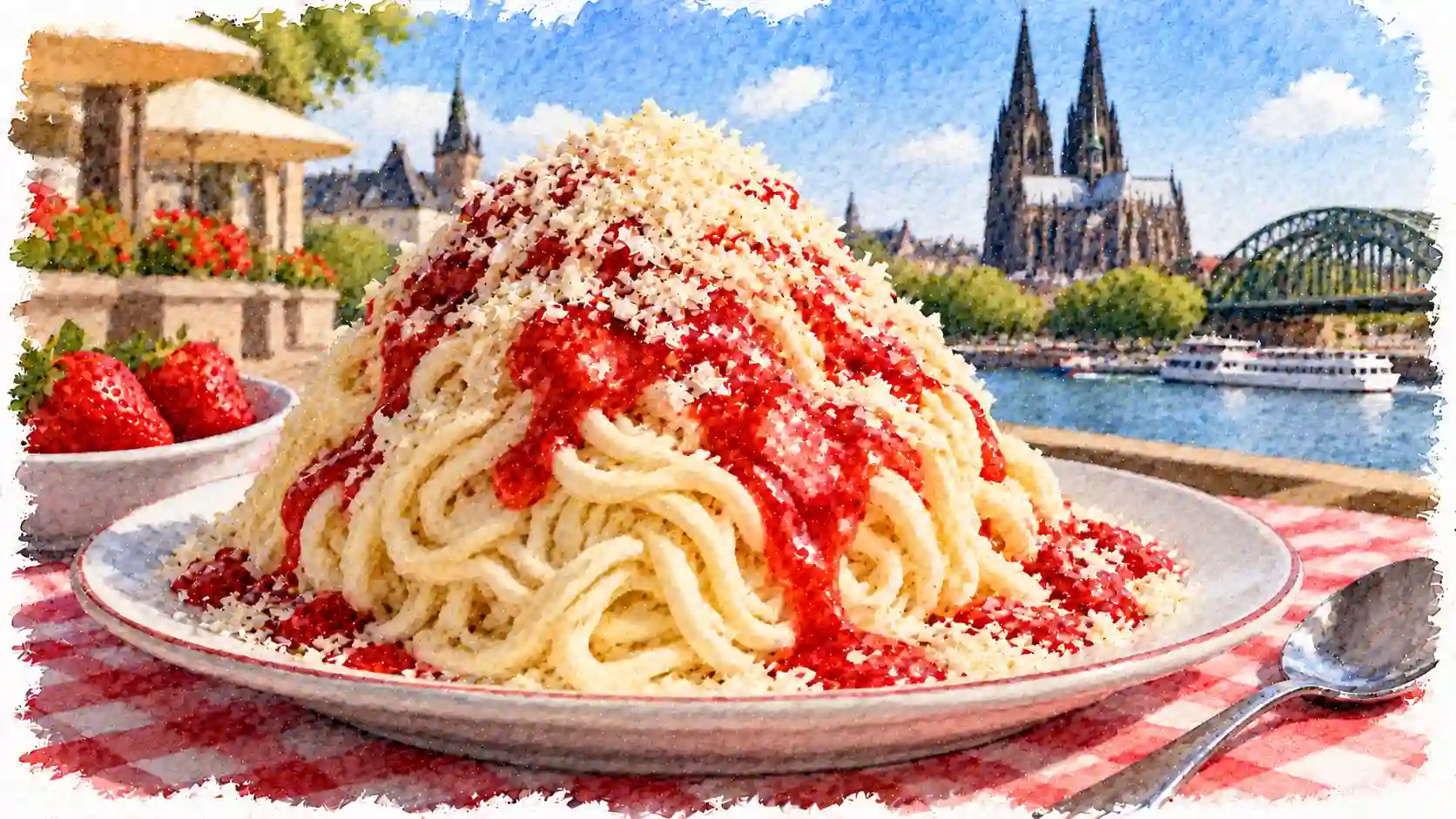
It looks like a plate of spaghetti covered in tomato sauce and grated cheese, but this playful German dessert contains no pasta at all. Spaghettieis is made by pressing vanilla ice cream through a special press to create long, noodle-like strands, then topping them with strawberry sauce and shavings of white chocolate. A bed of whipped cream adds a soft, creamy base. The result is a clever visual illusion that has become a summertime favorite in German ice cream parlors.
What Is Spaghettieis?
Spaghettieis, also written as Spaghetti-Eis, is a German ice cream dessert designed to resemble a serving of Italian spaghetti. Its name combines Eis, the German word for ice cream, with “spaghetti,” describing the shape of the frozen strands.
The classic version starts with vanilla ice cream that is pushed through a spätzle press or a suitable potato ricer. This creates thin strands that look remarkably like noodles. The strands are arranged over whipped cream, covered with strawberry sauce that resembles tomato sauce, and finished with grated or shaved white chocolate to imitate Parmesan cheese.
Despite its savory appearance, Spaghettieis is an entirely sweet dessert. Its appeal comes from the contrast between its familiar pasta-like presentation and its unmistakably creamy, fruity flavor. It is usually served in a shallow bowl or on a plate, where the strands and toppings can be displayed clearly.
Quick Facts
- Origin: Mannheim, Germany
- Created: 1969
- Creator: Dario Fontanella, a German ice cream maker from an Italian family
- Main ingredients: Vanilla ice cream, whipped cream, strawberry sauce, and white chocolate
- Texture: Creamy, cold, and soft, with a smooth fruit topping
- Appearance: Spaghetti-like ice cream strands with red sauce and white shavings
- Popular season: Spring and summer
- Typical serving: A plate or bowl, usually eaten with a spoon
Common Ingredients
The traditional Spaghettieis recipe uses a handful of familiar dessert ingredients. Each one contributes to the illusion of a savory pasta dish.
- Vanilla ice cream: The main ingredient, chosen for its pale color and smooth consistency. It needs to be firm enough to hold its shape but soft enough to pass through a press.
- Whipped cream: Placed underneath the ice cream strands, it adds richness and creates a soft base for the spaghetti-like mound.
- Strawberry sauce: Fresh strawberries blended into a smooth sauce, or a prepared strawberry topping, provide the red color associated with tomato sauce.
- White chocolate: Finely grated or shaved white chocolate imitates Parmesan cheese while adding sweetness and a delicate texture.
- Fresh strawberries: An optional garnish that adds color and reinforces the fruit flavor.
Some recipes add a little sugar or lemon juice to the strawberry sauce to adjust its sweetness and flavor. Other versions use different ice cream flavors or toppings, but vanilla, strawberry, whipped cream, and white chocolate remain the familiar combination.
How Spaghettieis Is Prepared
Preparation is simple in principle, but temperature and timing make a difference. The serving plate and the press may be chilled first, helping the ice cream remain firm while it is shaped. A cold press can be especially useful because the ice cream softens quickly when it comes into contact with warmer equipment.
Whipped cream is placed on the plate as a base. The vanilla ice cream is then loaded into a spätzle press or suitable potato ricer and pushed through its small holes. As the strands emerge, they are arranged in a loose mound over the cream, creating the appearance of spaghetti.
Next, strawberry sauce is spooned over the ice cream noodles. Finally, white chocolate is grated across the top to resemble a sprinkling of Parmesan. The dessert is served immediately, before the strands soften and lose their shape.
Unlike desserts that require baking or lengthy chilling, Spaghettieis is assembled just before serving. Its characteristic appearance depends on the ice cream being cold enough to form distinct strands, so working quickly is part of the process.
History & Origins
Although Spaghettieis looks like an Italian-inspired dessert, it was created in Germany. Its origins are traced to Mannheim, where Dario Fontanella introduced the dessert in 1969 at his family's ice cream business.
Fontanella's idea was inspired by Mont Blanc, a European dessert made with sweetened chestnut purée pressed into fine strands. After seeing this technique during a visit to Italy, he experimented with applying a similar method to ice cream. In his first successful experiments, he used different ice cream flavors to create the colors of the Italian flag.
The familiar version came later: vanilla ice cream formed the noodles, strawberry purée stood in for tomato sauce, and grated white chocolate imitated Parmesan. Fontanella's playful creation became popular in Mannheim and spread to ice cream parlors across Germany.
Today, Mannheim remains closely associated with Spaghettieis, but the dessert is widely available throughout Germany. It has also attracted attention outside the country as an example of how an inventive presentation can transform familiar ingredients into an entirely new eating experience.
Varieties & Differences
The classic recipe is easy to recognize, but ice cream makers have developed variations that play with the spaghetti theme while keeping the same basic idea. These are creative interpretations rather than a standardized set of traditional varieties.
- Classic Spaghettieis: Vanilla ice cream strands, whipped cream, strawberry sauce, and grated white chocolate.
- Chocolate Spaghettieis: Chocolate ice cream is pressed into strands for a darker variation, sometimes paired with chocolate sauce or other toppings.
- Fruit variations: Some shops substitute other fruit sauces or add fresh fruit, creating different colors and flavors while preserving the noodle-like form.
- Creative themed versions: Some ice cream parlors experiment with savory-dish-inspired names such as “Carbonara” or “Bolognese,” using pale creams, chocolate, caramel, or nuts to imitate familiar pasta toppings.
These variations are not universal recipes, and availability depends on the individual shop. The classic combination of vanilla ice cream, strawberry sauce, whipped cream, and white chocolate remains the version most closely associated with Spaghettieis.
How Spaghettieis Is Enjoyed
Spaghettieis is a familiar sight in German ice cream parlors, particularly during warmer months. It is often ordered as an individual sundae and served in a dish wide enough to show off the long strands. The first impression is visual: from a short distance, it can genuinely resemble a plate of pasta.
Once tasted, the dessert reveals a simple combination of creamy vanilla, cool whipped cream, sweet-tart strawberry sauce, and white chocolate. The fruit topping balances the richness of the dairy, while the chocolate adds sweetness and a little texture.
Its playful presentation makes it popular with families, but the appeal is not limited to children. For many people, Spaghettieis is also a nostalgic summer treat associated with visits to neighborhood ice cream shops. It is usually eaten with a spoon, gathering a little of the ice cream, sauce, and cream in each bite.
Did You Know?
Spaghettieis was inspired by a chestnut dessert called Mont Blanc. After seeing chestnut purée pressed into strands, Dario Fontanella tried a similar technique with ice cream. His experiments in Mannheim in 1969 led to a German classic that looks like pasta but tastes like dessert.
A German Dessert with a Playful Twist
Spaghettieis shows how a small change in shape can make familiar ingredients feel entirely new. Vanilla ice cream becomes noodles, strawberry sauce takes the place of tomato, and white chocolate stands in for Parmesan. Since its creation in Mannheim in 1969, this imaginative dessert has become a recognizable part of German ice cream culture, and a reminder that a little culinary creativity can be just as memorable as a complex recipe.