
Beggar's Chicken
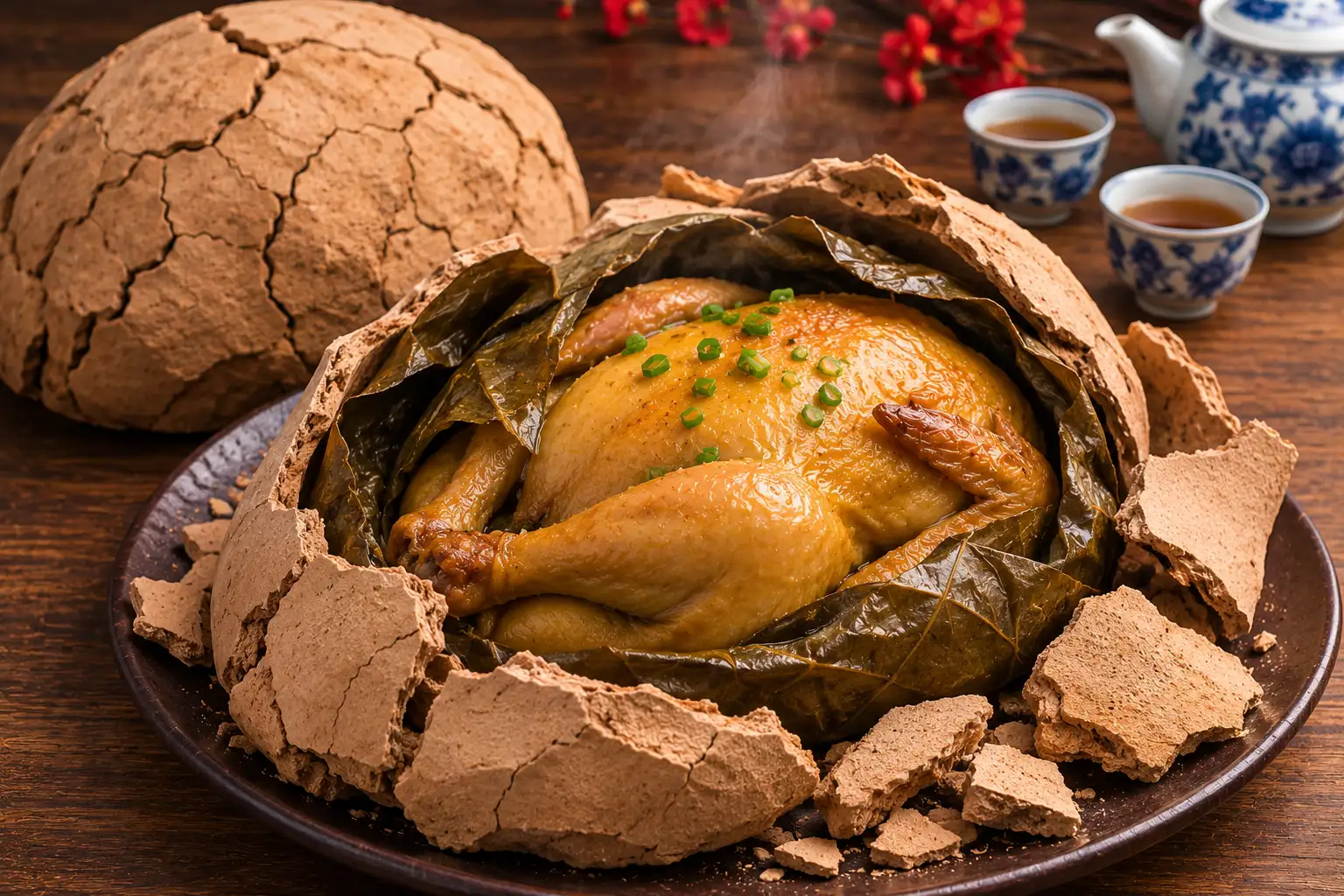
Imagine a restaurant serving what looks like a solid mound of baked clay. When the shell is carefully cracked open, fragrant steam escapes, revealing a whole chicken wrapped in aromatic lotus leaves. This is beggar's chicken, one of China's most memorable traditional dishes. Known as jiàohuā jī, it is especially associated with the Jiangnan region of eastern China, including Changshu in Jiangsu Province and Hangzhou in Zhejiang Province. Its slow, enclosed cooking method produces exceptionally tender meat, while a famous folk tale tells of a resourceful beggar who discovered the dish by accident.
What Is Beggar's Chicken?
Beggar's chicken is a traditional Chinese dish made by seasoning and often stuffing a whole chicken, wrapping it in lotus leaves, sealing it in a clay shell, and cooking it slowly over heat.
Its Chinese name, 叫花鸡 (jiàohuā jī), refers to a beggar. The dish is also sometimes written as 叫化鸡. Despite its humble-sounding name, modern beggar's chicken can be an elaborate restaurant specialty requiring careful preparation and several hours of cooking.
The most distinctive part of the cooking technique is the outer casing. Traditionally, damp clay hardens around the wrapped chicken as it heats. The enclosure helps retain moisture, allowing the chicken and its seasonings to cook together.
When the shell is broken and the lotus leaves are opened, the meat is tender, juicy, and aromatic. Depending on the recipe, its flavor may include ginger, scallions, Shaoxing wine, mushrooms, ham, and other savory ingredients.
Beggar's chicken is especially associated with Changshu, a city near Suzhou, although Hangzhou also has a celebrated version. The two regional traditions are closely related, and historical accounts of the dish's development are not entirely consistent.
Quick Facts
Quick Facts
- Country: China
- Region: Jiangnan, particularly Jiangsu and Zhejiang provinces
- Chinese name: Jiàohuā jī (叫花鸡 or 叫化鸡)
- Famous localities: Changshu and Hangzhou
- Main ingredient: Whole chicken
- Traditional wrapping: Lotus leaves enclosed in a clay shell
- Common seasonings: Ginger, scallions, Shaoxing wine, and salt
- Possible stuffing: Mushrooms, bamboo shoots, ham, and dried seafood
- Cooking method: Slow baking or roasting inside a sealed casing
- Texture: Very tender, moist, and succulent
- Distinctive presentation: Breaking open the hardened outer shell
Common Ingredients
Beggar's chicken can be relatively simple or richly seasoned. Traditional restaurant preparations often use a whole bird with several aromatic ingredients inside the cavity.
- Whole chicken: The centerpiece of the dish. Some Changshu recipes favor a tender, locally raised yellow-feathered chicken.
- Lotus leaves: Wrapped around the chicken to create an aromatic inner layer and separate the food from the outer casing.
- Clay: Traditionally used as the external cooking shell. Modern versions may substitute a suitable dough crust or another oven-safe enclosure.
- Shaoxing wine: A Chinese cooking wine used in many versions to add aroma and savory depth.
- Ginger and scallions: Familiar aromatics that flavor the meat during cooking.
- Shiitake mushrooms: Frequently included in the stuffing for their earthy, savory taste.
- Bamboo shoots: Add a delicate vegetal flavor and contrasting texture.
- Chinese ham: Used in some traditional preparations for extra saltiness and richness.
- Dried shrimp or scallops: Optional ingredients that contribute concentrated umami.
- Seasonings: Salt, soy sauce, and spices may be used according to local or family recipes.
Some elaborate preparations also wrap the chicken in pork caul fat before adding the lotus leaves. This contributes richness and helps protect the bird from drying during the long cooking process.
How Beggar's Chicken Is Prepared
The traditional process begins with a cleaned whole chicken. The bird is seasoned or marinated, often with salt, cooking wine, ginger, scallions, and other aromatics.
Depending on the recipe, the cavity is filled with ingredients such as mushrooms, bamboo shoots, ham, or dried seafood. These cook inside the bird, adding flavor to the juices that collect during roasting.
The prepared chicken is then wrapped securely in lotus leaves. The leaves provide a protective barrier and contribute a subtle vegetal fragrance. Some versions include an additional food-safe wrapping layer.
Next comes the most recognizable step: enclosing the wrapped chicken in a thick layer of prepared clay. The shell is shaped around the package and sealed before being placed over or inside a heat source.
Traditional versions are slowly baked over embers or in a controlled fire, while contemporary restaurants commonly use ovens. The cooking may take several hours, depending on the bird's size and the technique.
As the clay heats and hardens, the enclosed chicken cooks in a moist environment. Its own juices and the aromatic ingredients remain largely trapped within the wrapping, producing tender meat with a concentrated savory fragrance.
At serving time, the shell is carefully cracked and removed. Opening the lotus-leaf wrapping releases steam and reveals the cooked chicken inside.
Food-safety consideration: Ordinary garden clay, construction materials, or unidentified mud should not be used to prepare food. These materials may contain harmful contaminants. Traditional clay cooking requires suitable materials and specialized knowledge. For home cooking, a properly designed food-safe alternative is more practical. The chicken and any stuffing must be thoroughly cooked, with the thickest part reaching a safe internal temperature of 165°F (74°C).
History & Origins
Beggar's chicken belongs to the culinary traditions of Jiangnan, the region south of the lower Yangtze River known for its refined cooking, freshwater ingredients, and careful preparation techniques.
Its best-known origin story is set in Changshu, Jiangsu Province. According to local legend, a hungry beggar obtained a chicken but had neither a cooking vessel nor the necessary equipment to prepare it conventionally.
The beggar supposedly coated the bird in mud and placed it over a fire. When the hardened shell was broken open, the chicken was unexpectedly tender and fragrant.
In some versions of the story, the smell attracted the attention of a wealthy or influential passerby. The improvised preparation was eventually adapted with better ingredients and more elaborate seasoning, becoming a celebrated dish.
Other variations connect the story with late Ming or early Qing China. However, the details differ, and there is insufficient evidence to identify a particular beggar or a precise invention date.
Changshu remains strongly associated with the dish. The city's traditional preparation, including its use of lotus leaves and clay, is recognized as part of local intangible cultural heritage.
Hangzhou also developed a well-known interpretation, sometimes called Hangzhou beggar's chicken or jiàohuā tóngjī. Restaurants in both Jiangsu and Zhejiang helped transform the rustic cooking idea into a distinctive regional specialty.
Varieties & Differences
Although the sealed chicken and aromatic wrapping define the dish, regional and modern versions differ in several ways.
- Changshu beggar's chicken: A traditional Jiangsu preparation associated with carefully seasoned whole chicken, savory stuffing, lotus leaves, and a clay casing.
- Hangzhou beggar's chicken: A closely related Zhejiang specialty often featuring Shaoxing wine, aromatic leaves, and slow roasting.
- Stuffed beggar's chicken: An elaborate version filled with mushrooms, bamboo shoots, ham, or dried seafood.
- Clay-sealed beggar's chicken: The classic presentation in which a hardened outer shell is broken at the table or before serving.
- Dough-wrapped beggar's chicken: A modern adaptation that uses an oven-safe dough enclosure instead of clay.
- Foil-wrapped or covered-oven chicken: A simplified version inspired by the same moist, enclosed cooking principle, although it lacks the traditional clay-shell presentation.
Beggar's chicken is sometimes compared with salt-baked chicken, another Chinese poultry specialty. The dishes share an interest in enclosing chicken during cooking, but their traditions and techniques differ. Salt-baked chicken is especially associated with Hakka cuisine, while beggar's chicken is more closely identified with Jiangnan and its lotus-leaf-and-clay preparation.
How Beggar's Chicken Is Enjoyed
Beggar's chicken is often presented as a special-occasion dish, particularly in restaurants specializing in Jiangsu or Zhejiang cuisine. Its elaborate preparation and dramatic appearance make it suitable for a shared meal.
The moment when the clay shell is cracked open is an important part of the experience. The outer casing gives little indication of the food inside, making the reveal both theatrical and aromatic.
Once the wrapping is removed, the chicken is portioned and shared. The meat is usually tender enough to separate easily from the bones, while the stuffing and cooking juices add savory richness.
Its flavor is generally more fragrant than spicy. Lotus leaves, cooking wine, ginger, mushrooms, and other aromatics create a complex but balanced taste, with the natural flavor of the chicken remaining central.
The dish can be enjoyed alongside rice, vegetables, or other foods in a Chinese banquet-style meal. Some versions are served with the stuffing and juices arranged around the chicken.
For diners unfamiliar with the dish, its most surprising feature is often the contrast between the rough, hardened exterior and the soft, fragrant meat inside. What appears to be an object made of clay becomes an unexpectedly elegant centerpiece.
Did You Know?
The clay shell in traditional beggar's chicken is not meant to be eaten. It acts as an outer cooking enclosure, while lotus leaves and other suitable wrapping materials separate the chicken from the clay. Breaking open the shell reveals the tender bird and releases the fragrant steam trapped inside.
From Humble Legend to Celebrated Chinese Dish
Beggar's chicken is a memorable example of how a cooking technique can become part of a region's culinary identity. Whether its famous origin story reflects a real event or generations of imaginative storytelling, the dish remains closely connected with Changshu, Hangzhou, and the food traditions of Jiangnan. Its aromatic lotus leaves, savory stuffing, tender meat, and dramatic clay-shell presentation transform a whole roasted chicken into something extraordinary. Today, beggar's chicken continues to celebrate the creativity, craftsmanship, and rich regional diversity of Chinese cuisine.