
Kunga Cake
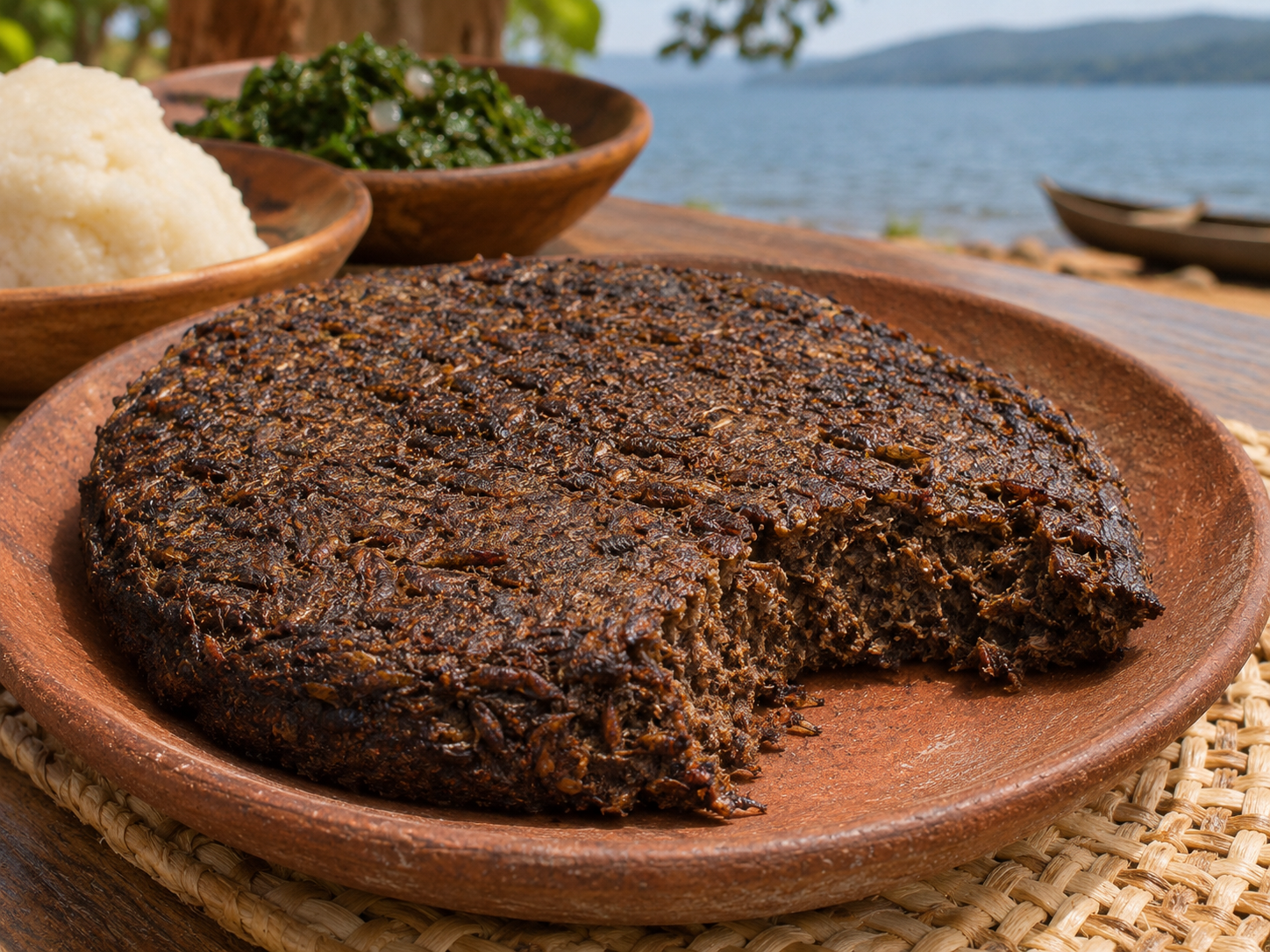
Imagine a cloud of tiny flies so dense that it looks like smoke rising above a lake. Around Lake Malawi, these spectacular swarms are more than a natural spectacle: they're a seasonal food opportunity. Local harvesters sweep thousands of the insects from the air, remove unwanted material, and press them into compact patties known as kunga or kungu cakes. The main ingredient is an adult phantom midge called Chaoborus edulis, not a worm or an aquatic larva. Once collected, the insects can be baked, boiled, or pan-fried. It's one of Malawi's most unusual traditional foods, turning an extraordinary natural event into something people can eat.
What Is Kunga Cake?
Kunga cake is a traditional food associated with communities around Lake Malawi. It is made by collecting large numbers of tiny flying insects, commonly called lake flies, and compressing them into dense cakes or patties. The insects most closely associated with the Lake Malawi tradition are adult Chaoborus edulis, a species of phantom midge in the family Chaoboridae.
Despite their resemblance to mosquitoes, these flies are non-biting. Their aquatic immature stages develop in the lake, but the insects collected for food are adults that emerge and gather in enormous swarms above the water and along the shoreline.
The name kunga is associated with these compacted insect foods, while a recent study from Malawi records the local name nkhunga for cakes made from C. edulis. These are not cakes in the conventional bakery sense. The insects themselves form the main ingredient, with no ordinary flour-based batter needed to hold them together.
The finished cakes are dark, dense, and compact. Their flavor and texture depend on how they are cooked. They may be baked, boiled, or pan-fried, and are an example of how communities around the lake make use of a remarkable seasonal natural resource.
Quick Facts
- Food Category: Edible insects and traditional Malawian food
- Origin: Communities around Lake Malawi
- Main Ingredient: Adult lake flies, especially Chaoborus edulis
- Insect Family: Chaoboridae, the phantom midges
- Seasonality: Depends on local swarming patterns and location
- Typical Flavor: Varies with the preparation method
- Preparation: Collected, cleaned, compressed, and baked, boiled, or pan-fried
- Common Uses: Traditional food and a seasonal source of nourishment
Common Ingredients
Kunga cakes are notable for their simple composition. The insects themselves make up the main ingredient, and traditional preparations do not necessarily require a separate batter or elaborate seasoning. A recent study of lake-fly cakes from Malawi prepared the samples without salt or other condiments.
- Lake Flies: The principal ingredient, especially adult Chaoborus edulis collected from swarms.
- Banana Leaves: Used to wrap cakes in some baking and boiling methods.
- Water: Used when cakes are boiled.
- Cooking Oil: Used for pan-frying, depending on the preparation.
- Salt and Seasonings: May be added in individual recipes, although they are not necessary for the basic cake.
These additions are not universal. The simplest versions rely primarily on the collected insects, with the preparation method shaping the finished food's texture and flavor.
How Kunga Cake Is Prepared
Preparation begins when large swarms of adult lake flies appear around Lake Malawi. The insects can gather in extraordinary numbers, forming towering clouds above the water or along the shoreline. These swarms are part of the flies' reproductive behavior, as adults emerge and gather to mate.
Harvesters collect the insects using containers, basins, or woven baskets attached to long poles. A recent study in Malawi describes collectors using baskets fixed to sticks about three meters long. By holding the other end of the stick and whirling the basket through the air or around branches where the flies gather, they can collect large quantities of insects.
After collection, the insects are sorted to remove foreign material and unwanted debris. They are then pressed together into dense cakes. Because the insects are so small and are gathered in large numbers, they form compact patties without a conventional flour-based mixture.
Cooking methods vary. A 2026 study of traditionally prepared lake flies from Malawi examined three methods: baking, boiling, and pan-frying. In the baking method, cakes were wrapped in banana leaves and heated over slowly burning wood chips. For boiling, the wrapped cakes were placed in water and cooked in a pot. The pan-fried version was cooked in oil on a charcoal burner.
These methods produce different results. Baking, boiling, and frying affect the cakes' moisture, texture, and nutritional composition. In the study's taste evaluations, pan-fried lake flies received the highest overall consumer preference, while baking retained more protein and certain nutrients.
Some cakes may also be dried or further processed for handling and storage. Drying can reduce moisture, but it does not automatically make food safe for indefinite storage. Clean collection, thorough processing, protection from contamination, and suitable storage conditions remain important.
History and Origins
Kunga cake is associated with communities around Lake Malawi, one of Africa's largest freshwater lakes. The lake supports an enormous population of aquatic organisms, including phantom midges whose adult stages can emerge in spectacular numbers. For people living along the shoreline, these swarms provide an unusual seasonal food resource.
The best-known lake fly associated with this food is Chaoborus edulis. Its immature stages live in the water, where the larvae feed on small aquatic organisms. When they develop into adults, the flies emerge from the lake and form large swarms. It is these flying adults that are collected and pressed into food cakes.
Scientists have studied the swarming behavior of C. edulis in Lake Malawi. Research published in 2000 found that adult swarms occurred throughout the lake and throughout the year, although their timing and abundance varied by location. In the extreme south of the lake, swarms were observed mainly between November and March. This means the harvest should not be described as occurring in one identical season everywhere around the lake.
Local communities have developed ways to turn this temporary abundance into food. Collecting insects in large quantities and compressing them into cakes makes them easier to handle and cook than loose flies. The practice demonstrates how traditional food knowledge can make use of a resource that appears in extraordinary numbers but is difficult to gather individually.
Historical entomological literature also documents compacted cakes made from Chaoborus flies around Lake Malawi. A 1970 scientific bibliography refers to kunga cakes made from masses of these flies, showing that the food was already known to researchers decades ago. The broader practice of eating swarming lake flies is also documented around other African lakes, although the species and preparation methods are not necessarily the same.
Kunga remains a distinctive part of food culture around Lake Malawi. Its significance is not simply that it uses an unusual ingredient, but that it reflects knowledge of the lake's ecology, the behavior of its insects, and the ways communities make use of seasonal natural resources.
Preparation Methods and Differences
Kunga cake is defined by its insect-based ingredients and compressed form, but the finished food can differ according to how it is cooked and whether it is intended for immediate consumption or further processing.
- Freshly Compressed Kunga: Newly collected insects are cleaned and pressed into cakes before further cooking.
- Baked Kunga: Cakes are wrapped in banana leaves and heated over a slow fire.
- Boiled Kunga: Cakes are wrapped and cooked in water, producing a different texture from baking.
- Pan-Fried Kunga: Cakes are cooked in oil, creating a distinct flavor and texture.
- Dried Kunga: Cakes may be dried after processing to reduce moisture and make handling and storage easier when appropriate conditions are maintained.
These are preparation methods rather than fixed regional varieties, and not every community uses all of them. Texture and flavor depend on the insects collected, how tightly they are compressed, and the cooking or drying technique.
How Kunga Cake Is Enjoyed
Kunga cakes are eaten as a traditional food and provide an additional source of nourishment when lake flies are available in large numbers. Their compact form makes them easier to handle and prepare than loose insects, and processing allows communities to make use of a seasonal harvest.
The cakes may be eaten after baking, boiling, or frying, depending on local customs and household practices. Their taste and texture vary with the preparation method, so there is no single flavor profile that describes every version.
Research into the nutritional value of Lake Malawi's Chaoborus edulis has found that processing makes a difference. In a 2026 study, baked samples retained the highest measured protein levels, while pan-fried samples were rated most favorably for taste, texture, appearance, and aroma. The findings illustrate a practical trade-off between nutrient retention and consumer preference.
For people unfamiliar with edible insects, kunga cake may seem extraordinary. For communities around Lake Malawi, it represents a practical way to use a remarkable natural event as a food resource. The tradition also highlights the diversity of African food cultures and the many ways people have adapted their diets to the environments around them.
Did You Know?
The insects in kunga cakes are not aquatic larvae. They're adult phantom midges collected while flying in enormous swarms!
Chaoborus edulis spends its immature stages in Lake Malawi. When the insects emerge as adults, they can gather in dense clouds above the water and shoreline. Harvesters sweep them from the air using baskets attached to long poles.
Those tiny flies are then cleaned and compressed into cakes, turning a spectacular natural swarm into a traditional food.