
Stargazy Pie
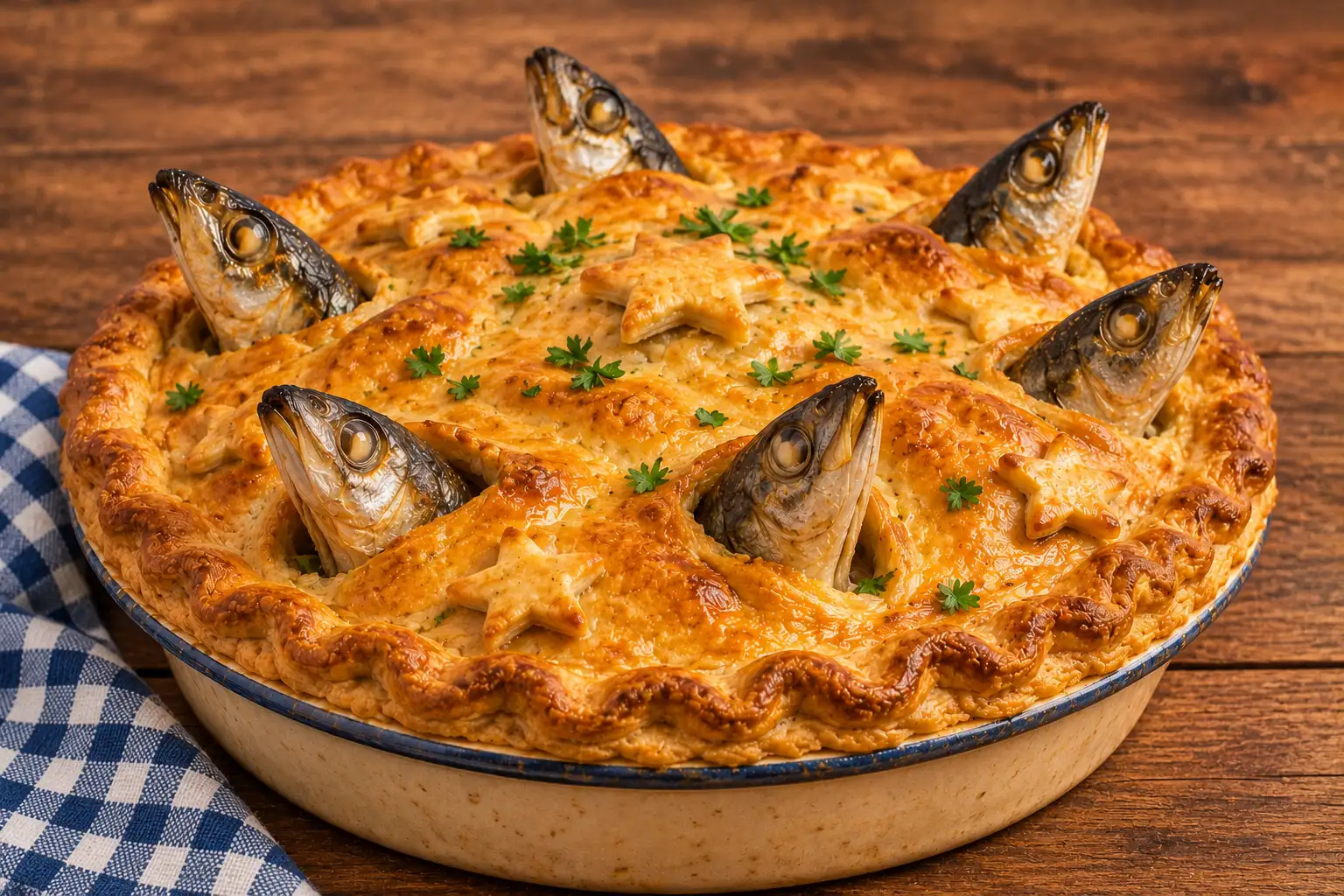
Golden pastry, savory fish, and several small heads gazing toward the ceiling make stargazy pie one of England's most recognizable traditional dishes. This extraordinary Cornish fish pie is famous for the pilchards or sardines that protrude through its crust, creating the appearance of fish looking up at the stars. Closely associated with the fishing village of Mousehole in Cornwall, stargazy pie is traditionally served during the December celebration of Tom Bawcock's Eve. Behind its unusual appearance lies a comforting seafood dish and a much-loved local legend about courage, generosity, and a community surviving a difficult winter.
What Is Stargazy Pie?
Stargazy pie, also spelled stargazey pie or starry gazey pie, is a traditional Cornish savory pie made with fish, often pilchards, baked beneath a pastry crust. Its defining feature is the arrangement of fish heads, and sometimes tails, so that they project through openings in the pastry.
The fish appear to be gazing upward, giving the dish its memorable name. Beneath the theatrical presentation is a filling that may contain potatoes, eggs, onions, herbs, and other savory ingredients.
Stargazy pie is especially associated with Mousehole, a historic fishing village near Penzance in southwestern Cornwall. It is closely connected with Tom Bawcock's Eve, traditionally observed on December 23.
Although photographs often emphasize the protruding heads, the edible portion of the dish is the cooked fish flesh and accompanying filling. In modern preparations, the fish may be deboned and cleaned while keeping the heads attached for presentation.
Its flavor is familiar to anyone who enjoys British fish pies: rich seafood, buttery or crisp pastry, and comforting savory ingredients. Its appearance, however, makes it unlike almost any other traditional pie.
Quick Facts
Quick Facts
- Origin: Cornwall, England
- Associated village: Mousehole, near Penzance
- Other spellings: Stargazey pie and starry gazey pie
- Main ingredient: Fish, traditionally pilchards or sardines
- Typical filling: Fish, potatoes, eggs, onions, and seasonings
- Crust: Savory pastry, often shortcrust or puff pastry
- Appearance: Golden pie with fish heads protruding through the crust
- Flavor: Savory, rich, and pleasantly fish-forward
- Traditional occasion: Tom Bawcock's Eve, December 23
- Cultural significance: Cornish fishing heritage and community celebration
Common Ingredients
There is no single universally accepted recipe for stargazy pie. Traditional and modern versions differ, but several ingredients appear frequently.
- Pilchards or sardines: The fish most strongly associated with the dish. Their heads are positioned to protrude through the pastry.
- Other fish: Some versions use mackerel, haddock, cod, or a mixture of locally available fish.
- Pastry: Forms the pie's golden top and provides the contrast between crisp crust and moist filling.
- Potatoes: A substantial ingredient used in many traditional preparations.
- Eggs: Often hard-boiled and sliced into the filling, although some recipes use eggs differently.
- Onions: Add sweetness and savory depth.
- Butter or cream: Included in some versions for richness and moisture.
- Herbs and seasoning: Parsley, pepper, salt, and other flavorings may be used.
- Bacon: An optional ingredient in certain Cornish recipes, adding a salty, smoky note.
The choice of fish is especially important. Historically, pilchards were abundant around Cornwall's coast and formed an important part of the local fishing economy. Their association with stargazy pie reflects that maritime heritage.
How Stargazy Pie Is Prepared
Preparing stargazy pie involves two challenges: creating a flavorful fish filling and arranging the fish so their heads remain visible above the crust.
The fish are cleaned and prepared first. Depending on the recipe, the backbone and some bones may be removed while the head is left attached. The fish must be handled carefully so that the decorative heads remain connected to the portions intended for cooking.
Potatoes, onions, eggs, and other ingredients are prepared separately. The filling is then arranged in a pie dish, sometimes with a sauce or additional moisture to prevent it from becoming dry.
The fish are positioned so their heads face upward or outward. Pastry is placed over the dish, with openings left for the heads to emerge. Some recipes also allow the tails to protrude, producing an even more striking appearance.
The pastry may be brushed with beaten egg to give it a glossy golden finish. The assembled pie is baked until the pastry is crisp and the fish and other ingredients are thoroughly cooked.
The finished dish is served in portions, usually with the exposed heads acting primarily as a visual feature rather than the focus of the meal.
For food safety, fresh fish should be cleaned and stored properly, any remaining bones should be considered when serving, and the filling should reach a safe cooking temperature. Using fish with attached heads does not change the need for careful preparation.
History & Origins
Stargazy pie is inseparable from the fishing heritage of Cornwall, a region whose coastal communities depended for centuries on the sea for food and employment.
The dish's best-known origin story concerns Tom Bawcock, a legendary fisherman from Mousehole. According to the tale, a prolonged winter storm prevented the village's fishing boats from going to sea, leaving the inhabitants dangerously short of food.
Determined to help, Bawcock supposedly sailed into the rough water and returned with enough fish to feed the village. His catch was baked into a large pie, with the heads protruding through the crust to show the abundance of fish inside.
The villagers were saved, and the occasion became associated with Tom Bawcock's Eve on December 23.
It is a memorable story, but its historical details are uncertain. Researchers and local historians have questioned whether Tom Bawcock was a documented historical figure, and the modern celebration has been shaped by twentieth-century efforts to revive Cornish traditions.
Descriptions of pies with fish heads extending through the crust nevertheless predate the modern revival. The dish's unusual design is therefore part of a broader history of Cornish cooking rather than simply a recent novelty.
Today, stargazy pie remains a symbol of Mousehole's identity and the connection between local food, folklore, and community memory.
Varieties & Differences
The basic idea of fish looking upward through pastry remains consistent, but stargazy pie has several variations.
- Traditional pilchard stargazy pie: The classic form using Cornish pilchards with heads protruding from a pastry crust.
- Mixed-fish stargazy pie: A version containing several types of fish, reflecting the variety of a coastal catch.
- Mackerel stargazy pie: A modern alternative using mackerel instead of pilchards or sardines.
- Egg-and-potato stargazy pie: A substantial filling combining fish with sliced hard-boiled eggs and potatoes.
- Creamy stargazy pie: A variation with a richer sauce beneath the pastry.
- Contemporary restaurant versions: Modern interpretations that may use different seafood, pastry types, or decorative arrangements while retaining the protruding fish-head motif.
Stargazy pie should not be confused with an ordinary British fish pie. Many British fish pies are topped with mashed potatoes and contain boneless pieces of fish in a creamy sauce. Stargazy pie is defined by the fish heads emerging through the top, most famously through a pastry crust.
How Stargazy Pie Is Enjoyed
Stargazy pie is most strongly associated with Tom Bawcock's Eve, celebrated in Mousehole on December 23. The occasion brings together the village's fishing history, local legend, food, and music.
The Ship Inn in Mousehole has played a prominent role in modern celebrations. Depending on the year, festivities may include sharing stargazy pie, singing the traditional Tom Bawcock song, and other community activities.
The dish is also prepared in homes and featured in cookbooks as an example of distinctive Cornish cuisine. It can serve as a memorable centerpiece for a winter meal or a celebration of regional food traditions.
When eaten, the pastry provides a buttery or crisp contrast to the moist fish filling. Pilchards offer a relatively rich seafood flavor, while potatoes, eggs, and onions create a comforting combination.
Despite the dramatic appearance, the dish is not necessarily challenging in taste. Someone familiar with sardines, mackerel, or baked fish pies will recognize many of its flavors.
For many people, the greatest appeal is the story behind the food. Stargazy pie turns a practical combination of fish and pastry into a visual celebration of Cornwall's relationship with the sea.
Did You Know?
The fish heads in stargazy pie are arranged to look as though they are staring at the stars. According to Mousehole's local legend, the protruding heads also showed villagers that the pie contained a generous catch of fish after a dangerous winter fishing trip. The story is commemorated on Tom Bawcock's Eve, December 23.
A Cornish Pie That Celebrates the Sea
Stargazy pie is one of England's most visually unusual traditional foods, but its lasting appeal comes from more than its appearance. The combination of fish, pastry, and hearty ingredients reflects Cornwall's historic reliance on coastal fishing, while the legend of Tom Bawcock gives the dish an enduring place in local storytelling. Whether enjoyed in Mousehole during December festivities or prepared as a special meal elsewhere, stargazy pie remains a distinctive expression of Cornish culinary heritage, community spirit, and the imagination found in traditional cooking.